What Is Resonance in Power Factor Correction? A Guide to Symptoms, Measurement Methods, and Risk Management
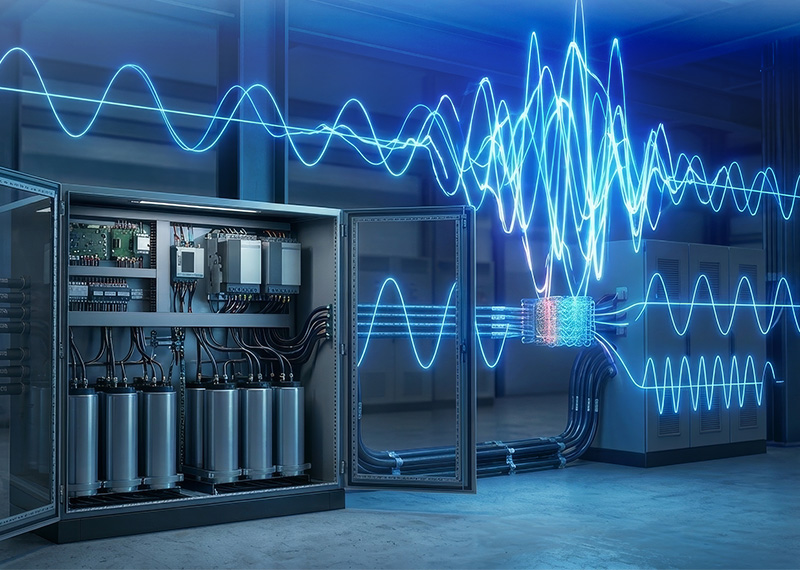
In electrical systems where certain conditions are met, the phenomenon where currents and voltages can rise to values significantly higher than expected at certain frequencies is referred to as resonance.
In electrical systems where certain conditions are met, the phenomenon where currents and voltages can rise to values significantly higher than expected at certain frequencies is referred to as resonance. In compensation applications, the issue of resonance is generally evaluated based on the interaction between compensation elements, the grid’s natural inductance, and the facility’s load structure.
Resonance cannot be defined as a component failure. This issue should be addressed as a behavior occurring within the facility’s power system and the resulting consequences of that behavior. Therefore, the proper way to understand resonance is not solely through panel-level monitoring but by reaching the actual conclusion through measurement and analysis.
Why Does Resonance Come into Play with Compensation Systems?
Reactive power demand is a condition that can fluctuate frequently, particularly in industrial facilities. In these facilities, rectifier-based power supplies, UPS systems, drives, and nonlinear loads can cause an increase in harmonic components within the system. Under certain conditions, these harmonics can interact with the system’s impedance characteristics, thereby increasing the risk of resonance.
When a compensation system is active in the facility, reactive power behavior changes. This situation creates a risk of resonance, particularly when harmonic levels exceed a certain threshold. Therefore, simply asking, “Is there compensation?” is insufficient. The most appropriate question to ask is: How do the facility’s harmonic content, grid conditions, and load profile, in conjunction with compensation, result in system behavior?
The Most Common Signs of Resonance in Compensation
Generally, resonance manifests itself not as a sudden failure but rather as a gradually increasing stress resulting from recurring issues. The most common signs encountered in the field are as follows:
1) Recurring failures in capacitors and compensation components
Situations arise that indicate the system is being subjected to abnormal stress. This manifests itself in an increased frequency of failures in compensation equipment, as well as premature aging of capacitors or a loss of performance at a faster-than-expected rate.
2) Unexpected tripping and erratic behavior of protective devices
There may be situations indicating that temporary but high-amplitude events can occur in the system. For example, the unexpected tripping of protective devices or circuit breakers.
3) Unusual heating in the panel and “unexplained” losses
Scenarios may arise where we can speak of a risk of resonance due to an increase in temperature in certain components or an overall increase in losses—phenomena that are not observable but can be detected using thermal methods.
4) Voltage distortion and increased harmonic levels
There are factors that significantly reduce the power quality of a facility. Voltage distortion is one of these factors. Fault records in drives and malfunctions in sensitive equipment are indicators of this.
Each of these indicators may be related to resonance. However, this situation alone cannot be considered definitive proof. As always, the conclusion that leads us to certainty comes from measurement and analysis.
How Is Resonance Risk Identified? (Measurement and Analysis)
Resonance analysis must be based on a properly planned measurement setup. We cannot base this analysis on a single measurement. The reason for this is that certain conditions in the facility arise only when specific loads are applied. Therefore, the following steps must be taken during the measurement:
1) Load profile analysis: When and which loads are active?
First, it is necessary to understand the facility’s operational schedule throughout the day. Moments such as when processes come online, shift changes, and high-torque starts are of critical importance.
2) Power quality measurement: Harmonic spectrum and voltage/current distortion
A common mistake is making decisions based solely on a single value. However, there are key points where spectrum analysis is critical. These include which harmonics are dominant, how they change over time, and the distribution of harmonic components.
3) Compensation behavior: Switching structure and system response
There are moments when you can gain a significant understanding of the issue in the system: By examining the gradual behavior of the compensation, the frequency of engagement and disengagement, and the system’s response during these moments, we can observe the problem.
4) Critical point verification: Matching symptoms with measurement findings
To achieve clarity regarding the symptom-cause relationship, thermal images, measurement data, the timing of tripping events, and fault logs must be evaluated simultaneously.
At Aha Teknoloji, our approach to analyzing system behaviors such as resonance involves collecting data through on-site measurements and then identifying the source of the risk through a facility-specific engineering assessment.
How to Manage Resonance Risk? (The Right Approach)
Since the source of the risk varies depending on factors such as the facility’s load profile, grid conditions, the nature of reactive power demand, and harmonic levels, there is no single resonance management method that fits every facility. We can summarize the management approach along these three axes:
1) Controlling harmonic effects
Harmonics can be one of the primary causes of increased resonance risk. Therefore, the source and levels of harmonics in the system must be identified, and a harmonic management plan tailored to the facility should be developed. Smart solutions such as AHF (Active Harmonic Filter) can help you achieve successful results in power quality management.
2) Managing reactive power demand dynamically and reliably
In facilities with rapid load changes, reactive power demand also fluctuates rapidly. In such facilities, you can use SVG (Static Var Generator) solutions to stabilize the system and ensure effective, dynamic reactive power management.
3) Post-measurement implementation: Design and field validation
To clearly determine whether the planned improvements will be sustainable, it is necessary to implement design decisions based on the measurement findings and conduct post-implementation evaluation measurements.
Conclusion
The issue of resonance in power factor correction—which often remains hidden within the system but eventually becomes a significant problem in terms of operational sustainability and costs—is an extremely critical point. In this article, we have addressed topics that may be related to resonance. As we have emphasized repeatedly, the most appropriate approach to this issue can only be achieved through a properly planned measurement and analysis study conducted on-site.
For questions regarding power quality and reactive power management, you can contact Aha Teknoloji to jointly plan measurement and analysis steps tailored to your facility.
